
Insects: Where Would We be Without Them?
By Senior Safina Fellow, Peter Kuper

Many of us view insects with revulsion, horror, and disgust without recognizing their intrinsic value in our daily lives. But how important are they really? The morning coffee that gets us through the day? That delicious chocolate we crave? Both would vanish without insect pollinators, along with apples, peaches, strawberries, cherries, apricots, almonds, carrots…in fact, grocery shelves would be virtually empty without these tiny giants.
Or, as the world-famous naturalist E.O. Wilson framed it:
“If all mankind were to disappear, the world would regenerate back to the rich state of equilibrium that existed ten thousand years ago. If insects were to vanish, the environment would collapse into chaos.”
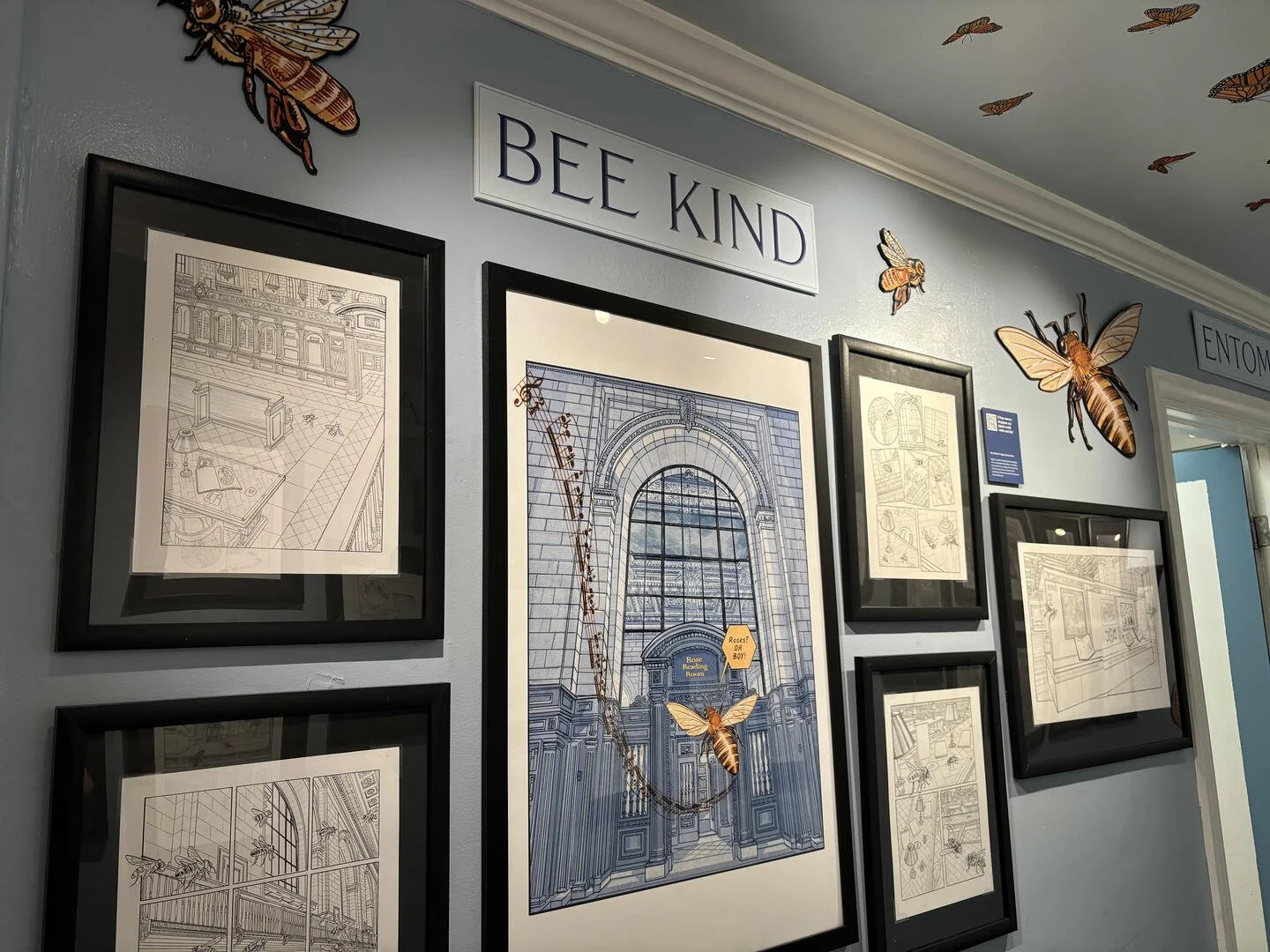
From a recent exhibition at the Society Of Illustrators , NYC
Insects’ story stretches back over 400 million years, and today it’s estimated there are 10,000,000,000,000,000,000 (ten quintillion) of them sharing our planet. During the Carboniferous Period, they were the first animals to take flight—an ancestor of dragonflies the size of a hawk, ruled the skies millions of years before birds came on the scene. They’ve survived mass extinctions of the past as well as our modern slaps, stomps, zaps, and boatloads of insecticides.
Our lives have been intertwined with these creatures throughout our history. In ancient Egypt, scarabs–also known as dung beetles– were seen as the embodiment of rebirth and worshiped as the solar god Khepri, whom Egyptians depended upon to roll the sun across the sky each day. Dung beetles are also the strongest animals for their size, able to pull the equivalent of three full cement trucks, and the first to be able to navigate by the stars. China’s economic rise was fueled by the cocoons of silk moths. Legend has it that silk was discovered in 2640 B.C.E. by a Chinese empress named Leizu, when a silk moth cocoon fell into her tea. Warmed by the liquid, it began to unravel and unravel and unravel –one cocoon can produce a thread a mile long. The source of the treasured fabric was kept secret for nearly 2000 years, and the lucrative Silk Road trade helped build dynasties. In Asia, dating back to 1200 B.C.E., the lac bug was cultivated to produce ‘stick lac’ which has been used in modern times to shellac floors, gave us 78 RPM records –for people who have any idea what those are– and put the shine on M&M’s and apples.
Gall Wasps help produce the iron gall ink, arguably the most important ink in Western history. Used since Roman times, its rich color and remarkable durability anointed it to pen the Declaration of Independence, the Magna Carta, Johann Sebastian Bach's music scores, and give luster to the drawings of masters, from Leonardo da Vinci to Rembrandt to Van Gogh.
The cochineal bug found in Oaxaca, Mexico, is responsible for the ’perfect red’ that made Spain a major power during the conquest in the 1500’s. The dyestuff that Hernán Cortés ransacked for Spain became as valuable as gold. Spain amassed a fortune selling the ‘grana,’ as the dried insects’ dyestuff was called, throughout the world. It became the royal color revered in France, the dye that gave the British their Red Coats, the stripes on the United States’ first flag, and illuminated the magnificent paintings of artists like Titian and Vermeer. Spain kept the dye’s source hidden for almost 250 years, though, in one of the earliest examples of biopiracy, the secret was almost exposed. In 1776, Thiérry de Menonville, a Frenchman financed by King Louis XVI, posed as a botanist and slipped into Veracruz, hoping to discover the source of the perfect red for his nation. As he meticulously recorded in his journal, after months without a hint of where to find the secret dye, he overheard some drunken sailors in a bar declaring the finest grana was to be found in Oaxaca, 600 miles to the south. De Menonville requested a travel permit from the Viceroy, but, suspicious of any foreigners, the Viceroy not only denied him the permit but also confiscated de Menonville’s passport and ordered him to depart on the next ship back to France, three weeks hence. De Menonville, desperate not to fail King and Country, chanced sneaking out of the city that night and headed south. Keeping off main roads to avoid capture by Spanish soldiers and certain death, he stumbled his way to Oaxaca. Remarkably, he was able to gather a quantity of the live cochineal bugs along with their food source, cactus, survive the arduous round trip, and slip out of Veracruz on a ship headed for a French colony, Saint-Domingue (today’s Haiti). De Menonville thought he was home-free but was collared by crew members who discovered him tending to his stash of insect booty. Thinking on his feet, de Menonville declared the cochineal-covered cactus was only for botanical use as a cure for gout–and the sailors bought it! When word reached France that he had succeeded in his mission, Louis showered him with silver and named him King’s Botanist. All de Menonville had to do was nurture the cochineal long enough to travel back to France, and the secret of the perfect red would be out. Unfortunately, in the sweltering island heat, he contracted malaria and, along with the unattended cochineal, died before he could reach Europe.
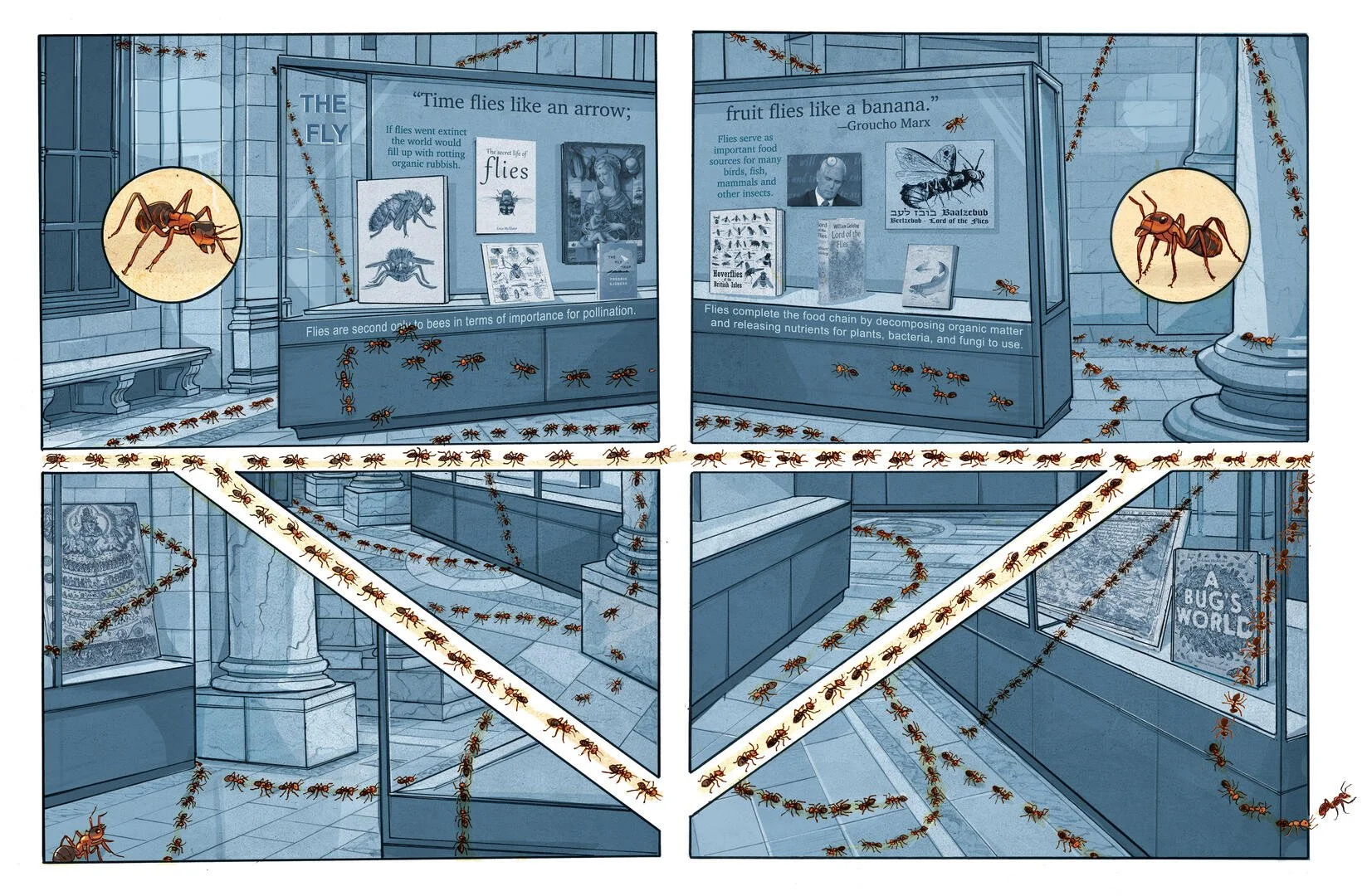
An excerpt from Insectopolis: A Natural History (W.W.Norton)
Primates have relied on insects throughout their evolution as a significant food source, and some theories suggest one of the reasons our ancestors came out of the trees was to forage for insects, which helped primates develop the use of tools to gather delectables like termites and ants. Today, two billion humans still depend on insects as an important part of their diet. Insects can provide as much protein as beef while leaving a carbon footprint that matches their diminutive size. If the thought of consuming insects and what they produce invokes the “yuck factor,” consider that the idea of eating raw fish repulsed many Westerners until the California roll introduced Americans to sushi. In the past, lobster was considered so lowly that it was only for prisoners. Now it’s a delicacy. Also, keep in mind you already have eaten insect products. From honey from bees, power bars with cricket flour, and the red coloring in your strawberry yoghurt, produced by cochineal (look for the ingredient ‘carmine’ or ‘natural red 4’), to the shine on apples and candy. Not to mention that the FDA allows a % of insect parts in most of our food –for example, pasta can have up to 225 insect fragments per 225 grams.
Whether we recognize it or not, as we scurry through our day, insects are keeping our planet thriving. If we can nurture them, they may be our guide to surviving into the future. So, give a thought before you stomp, perhaps place a flower on your windowsill or leave an unmown part of a yard, and most especially avoid pesticides. Let’s help them as they have helped us in our flight through history.