
On Technology, Ego and the Environment
By Safina Center Environmental History and Music Fellow Priya Parrotta
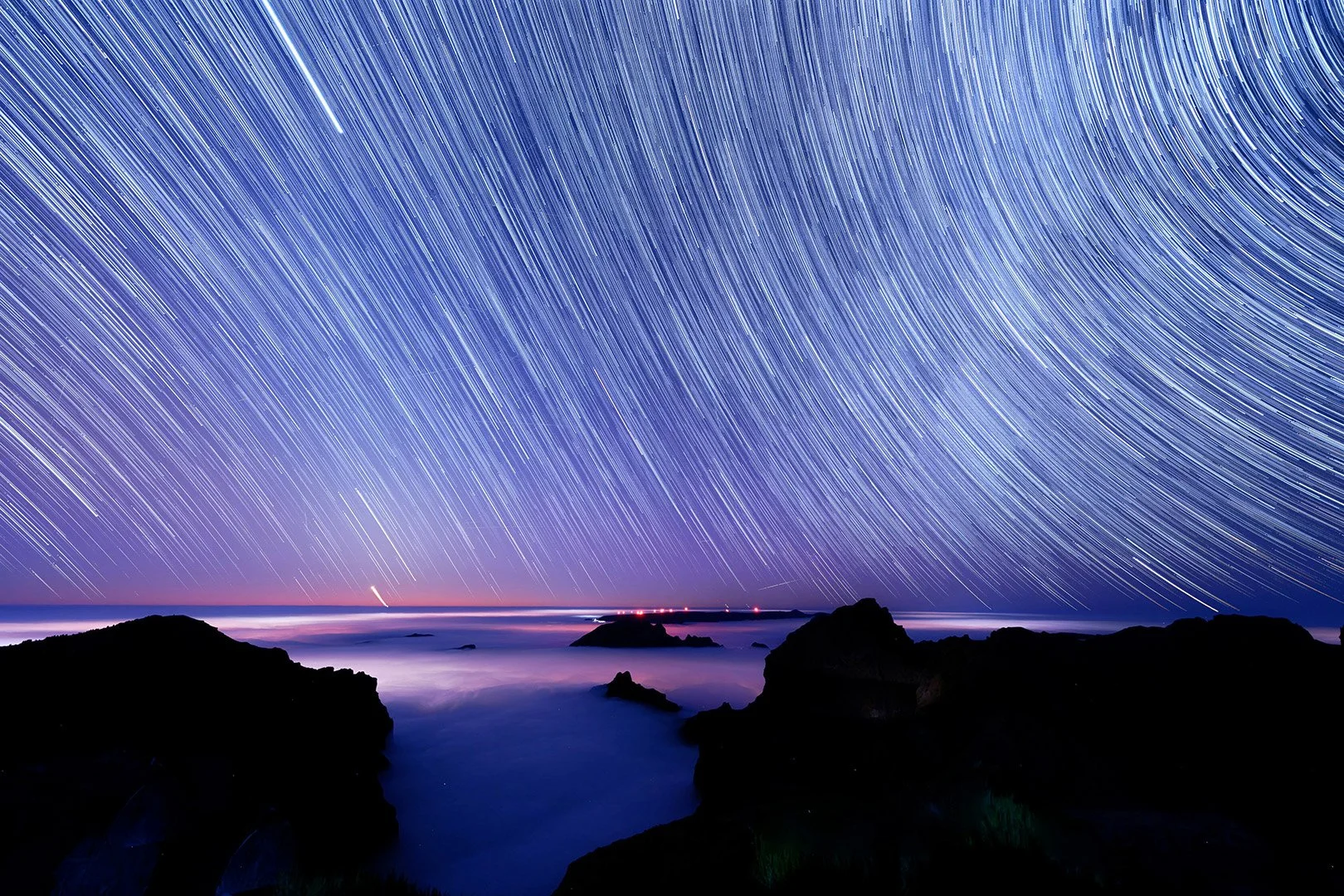
A star trail is seen in the sky above the ocean. ©Colin Watts, licensed under Unsplash+
In 2006, while visiting my grandparents in Bangalore, I asked my grandfather what it meant to be a spiritual person. Emerging from the volume of poetry he had been reading, and with a glint in his eye, he responded: ‘Spirituality is knowing that in this infinite creation, you are but a tiny, insignificant part… but you are a part.’ I took this to mean that living well was primarily about developing a sense of wonder, awe and respect for the beauty of the world—and then, seeking to find your small, positive place in that vast tapestry. Finding a way to honor the more-than-human world, while never forgetting how small you are within it. This is a hard thing to do under any circumstances, which is perhaps why so many sacred texts meditate upon the challenge of it. Sometimes I wonder if a true understanding of this is beyond our cognitive and philosophical capabilities; if so, that itself is a lesson in the limitations of our own selves and perspectives.
Several years later, while a postgrad student at Oxford, and at a high risk of losing that sense of perspective, I decided to see what life would be like without a phone. Given that I was living in a small town, seeing people in person, and could communicate with whomever I wanted via email anyway, I figured that it wouldn’t really feel like a big lifestyle change. Logistically speaking, I was right—but in a deeper, more personal sense, not having a phone led to some of the most meaningful and serendipitous experiences of my life. The friendships I found in those months were along the most beautiful I’ve ever had, giving me a deep sense of strength, and a renewed belief in the joy of the present moment. I spent long hours in the quiet magic of small bookstores and coffeeshops, reading environmental texts such as the work of the Romantic Poets who critiqued industrialization by celebrating sublime and/or everyday encounters with the natural world. I found myself exchanging long letters with friends and relatives elsewhere, sharing our inner and outer lives with sincerity and attention. And walking around town without the usual distractions ushered in certain mystical experiences, certain deep connections with the more-than-human world, which transformed the entire trajectory of my career.
Like pretty much everyone else, I now have a phone, but the memories of that time remain in my consciousness—made eternal, almost, by their aliveness. And very often, I find myself reflecting on the relationships between contemporary technology and environmental consciousness (which is a subject that several other Safina Center Fellows have explored extensively). I am particularly concerned by the impact that our addictions to our online identities have had upon our ability to truly appreciate, and truly understand, the majestic webs of life which sustain us, and which need our attention and our reverence.
Those closest to me know that I spend much of my time ruminating, persistently and usually unproductively, upon this issue. I’m grateful to be able to share these concerns openly with them, and to learn from their experiences. One of my dearest friends, for instance, came of age in Silicon Valley in the late 1980s and early 1990s, when a heady enthusiasm for the wonders of ‘cyberspace’ was reaching new heights. We met around the same time that social media became a key pillar of Millennial life, and over the years we have had many laughter-filled conversations about the latest trends in technology—and the ways in which these ‘developments’ have resulted in a historically unprecedented flattening and trivialization of our personal and social lives.
Unlike most of the people around us, we would usually come to the conclusion that whatever ‘development’ we were talking about was too absurd to be believed. We started off, in the early 2010s, talking about Facebook. A website that displayed your friendships numerically, as if connection even remotely works that way? What nonsense. As regards Instagram: an app that gave you the option of acquiring followers? Preposterous. Phones that made it really easy to take pictures of yourself, which you would then post with great frequency online, as evidence of your life events? Surely not! All of the above becoming professional qualifications, professional assets? Perish the thought! Young people treating their teachers with great disrespect, believing that they do not need to learn, because they could easily become social media ‘influencers’ instead? At this possibility, our laughter would end, turning into grave concern. Surely this was going too far. Surely, at some point, people would realize that all of this behavior stems from a certain gross misperception of who we are, and why we are here on this Earth. Surely this will end, we would hopefully conclude. So far, however, we have been entirely wrong.
Rather than being dismissed as silly sideshows, little games that are peripheral to the true responsibilities and joys of life, all of the above ‘developments’ have been globally embraced as life itself. This has had well-documented, catastrophic results for the health of young people in particular. And that fact makes me very sad. What is this mess that we have created? What is this strange, new reality, which is not only decimating countless kids’ well-being, but is also distracting us from the wonders of our beautiful planet, and the needs and lessons of our nonhuman relatives? I am heartened by the work of all of those who are directly confronting these questions, but I also worry about the relative absence of this conversation in the broader public sphere. I think it is time to remember that some of the world’s most enduring environmental philosophies question not only the physical destruction of the more-than-human world, but also cast light upon the spiritual roots of our disconnect from that world in the first place.
Many argue that we must fully embrace our current technological landscape if we are to challenge the systems of exploitation and extraction which now run roughshod over our Earth. While I understand where those arguments are coming from, I also disagree. I tend to be of the opinion that one of the most formidable barriers to environmentalism today is our relationship to our virtual world, and our virtual selves. This is true in a material sense: The ecological devastation required to produce our ephemeral devices is unspeakable. It is also true in a philosophical sense: If we believe that our virtual identities, our most shallow expressions of ourselves, are the mechanism by which we will play a role in the environmental movement, then what does that say about how we value others? If we are dependent on technologies that make us feel like our photos, posts and pronouncements matter far more than they actually do, then what are the consequences for our ability to recognize the beautiful insignificance of our own egos? And if we do not acknowledge the profound limitations of these technologies, and our participation in them, then how can we ever truly displace the anthropocentrism of our times?
I wonder if these kinds of questions will ever occupy the forefront of public discourse. I worry what will happen if they don’t—if we continue to pretend that these questions are not even valid. I sometimes find it hard to believe that we are not talking more about this issue, especially since it weighs upon me so heavily. I do hope that more people will start having deeper conversations about the connections between technology, ego and the environment soon. For as countless environmentalists have said, in different languages, in different places and at different times, wishing to change the world is futile unless we are also prepared to change ourselves.