
It’s the Consumption, Stupid
Jimmy Carter’s loss was greed’s win
By Safina Center Writer-in-Residence Paul Greenberg
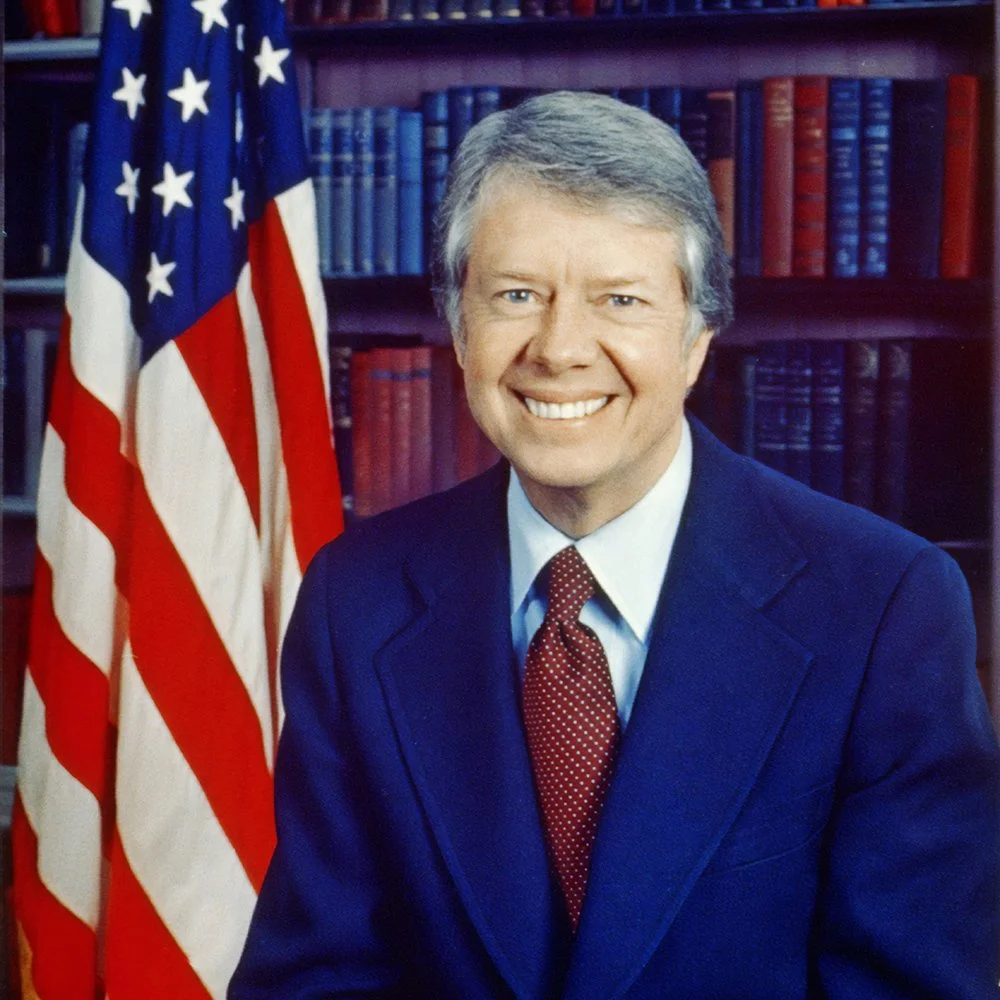
Photo by Library of Congress on Unsplash.
“Too many of us now tend to worship self-indulgence and consumption,” the late Jimmy Carter said during his first and only term as President of the United States. “Owning things and consuming things does not satisfy our longing for meaning . . . piling up material goods cannot fill the emptiness of lives which have no confidence or purpose.”
Has there ever been a more apt description of what ails America a quarter of our way into this greed-strewn 21st century of ours? Indeed, the material gluttony that so troubled Carter in the late 1970s seems harmless by comparison. Back then a single, hard-wired telephone was the only device sounding off in most American homes. A glass was the receptacle of choice for a drink of water. An air ticket to Europe or Asia was so expensive that most of us never ventured farther than a state park for our annual vacations.
And yet, Carter was on to something. Even if most of us on the surface seemed ok with a single car in our garages, he sensed what could happen if Americans were allowed to consume to their hearts’ desires. In his great, good, naïveté, he dared to broach the subject publicly. He dared during a standoff with global oil producers to implore Americans to turn down their thermostats a few degrees and don a sweater. He put a solar water heater on the roof of the Whitehouse. He told us to try to be happy with what we had. To seek contentment through love and family, not through possessions.
What did this call to our better angels bring Carter? Mostly mockery. Even Saturday Night Live, supposedly a vanguard of the American cultural left headed by a liberal Canadian producer had no qualms with burning up Carter’s political future on national television. One Christmas the show ran a mock political public service announcement from the Carters declaring a Y.E.A. — a Yuletide Emergency Alert in which all of us should turn off our Christmas tree lights.
All of this mockery, this disdain for getting what we want all the time, heralded in the great greedscape that has blighted this country for the last 45 years. At first it seemed the turn to rampant materialism with Ronald Reagan’s election win in 1980 might just be part of the alternating current of American politics; that we might soon turn back to a more modest incarnation of ourselves. Going along with having just one car in the garage.
But after two terms of Reagan, materialism put down roots. “Greed is good,” the fictional Gordon Gecko declared in the 1987 film Wall Street. In real life, the author Michael Lewis described a hedonism among financiers in his 1989 book Liar’s Poker that blew people away with its cruelty and brashness. Twenty years later when Lewis wrote The Big Short he reflected back on the metastasis of that greed that spanned both Republican and Democratic administrations. “I expected readers of the future would be appalled that in 1986 the CEO of Salomon Brothers was paid $3.1 million as he ran his business into the ground,” Lewis wrote in 2010. “What I never imagined is that the reader of the future might look back on any of this . . . and say, ‘how quaint.’”
How quaint indeed. But how amazing too, that James Earl Carter, a man of such dignity and kindness, was able for four short years to hold the reigns of power atop the most powerful nation on earth and sound out a warning. That his warnings stoked mostly laughter back then doubles back on us now. In 2024, while Carter lived out his 99th year on earth, that same earth endured its hottest year since humans set foot on the planet. Americans filled their cars with garages, their homes with devices, their oversized refrigerators with bottled water, and their vacation days with flights around the globe. We won the honor of being the most consumptive and carbon emitting people in history of civilization.
Who’s laughing now?