
Composting: From Food Scraps To Life
By Junior Fellow Isaias Hernandez
What if I told you the first time I ever composted, I was 23?
It happened when I was living alone for the first time in New Jersey, in a house with a spacious backyard. I built my very first slow compost pile, layering food scraps, dried leaves, moisture, and love. What seemed simple became a profound lesson in reciprocity. For the first time, I could see that what I consumed did not have to end up as waste but could return to the world as nourishment.
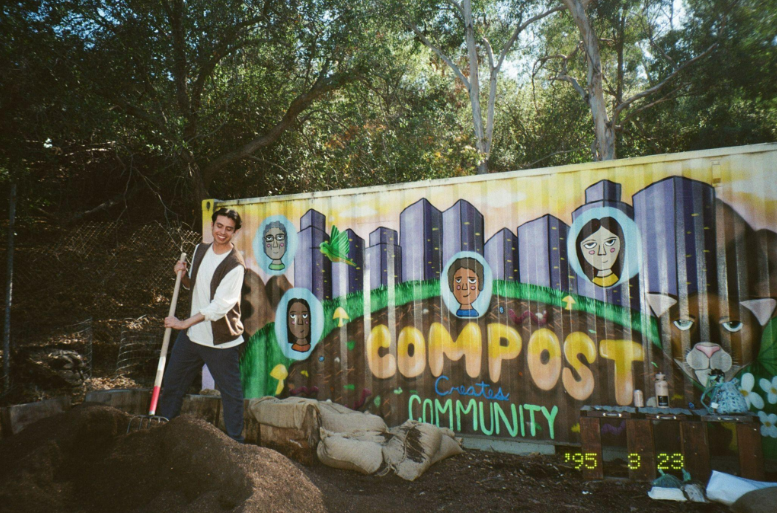
Photo by Isaias Hernandez, Isaias at Griffith Park Compost Hub Site
Fast forward a few years, and I’m back in Los Angeles (goodbye East Coast for good). For the upcoming episode of Teaching Climate Together, I wanted to explore one of our most underrated climate solutions: composting! I worked with LA Compost for this episode. LA Compost is a community-based non-profit that supports a healthy transition where food is never wasted but returned to the soil for the next cycle of life.
Composting: From Scraps to Soil ft. LA Compost
Why has composting been framed as dirty when it is one of nature’s oldest technologies?
Composting is the microbial transformation of nitrogen-rich “greens” like food scraps and carbon-rich “browns” like leaves, cardboard, and wood chips under oxygen-rich conditions. Bacteria, fungi, insects, moisture, and airflow work together to break organic matter down into humus, a dark, nutrient-rich soil amendment that improves water retention, supports plant roots, strengthens biodiversity belowground, and even helps soils store carbon.
When food waste is sent to landfills, it decomposes without oxygen and releases methane, a greenhouse gas far more potent than carbon dioxide in the short term. In Los Angeles, where landfill burdens often intersect with environmental justice, composting is more than waste diversion; it is a strategy to protect frontline communities.
What fascinated me most is how they’ve transformed composting into social infrastructure through a decentralized network of neighborhood hubs, schools, gardens, and farmers' market drop-offs across the city. Residents can bring scraps during their weekly market routine, and those materials are processed locally, often within less than 10 miles, before returning to nourish community gardens and urban farms.
In 2025 alone, their network diverted nearly 1 million pounds of organics from landfill through local community engagement. Composting is how we can regenerate our land and relationships with residents.