
What is the ecological cost of war?
A reflection on the legacy of war and ecological trauma on the Black psyche by Junior Fellow Nia Williams
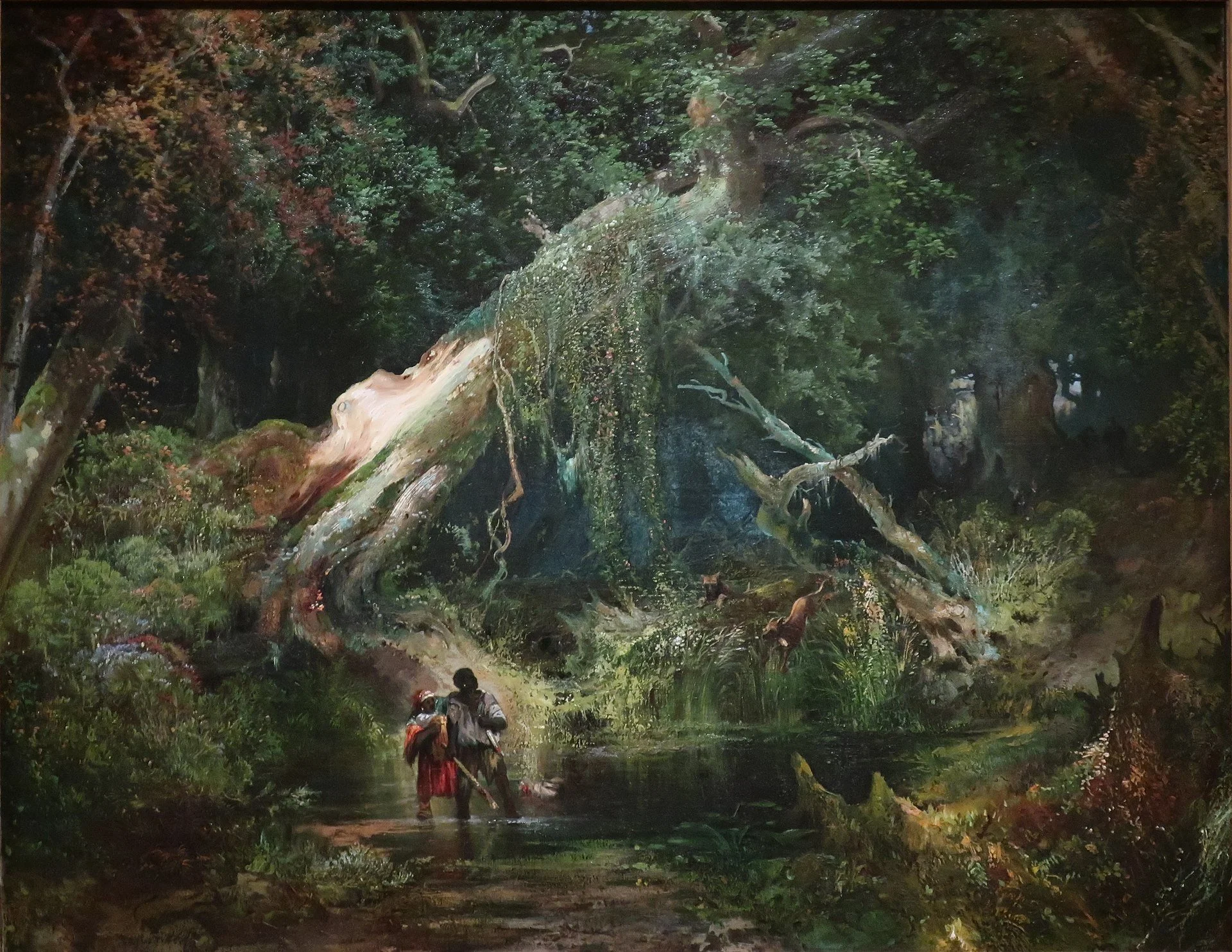
Slave Hunt, Dismal Swamp, Virginia by Thomas Moran, 1862
In his timeless memoir, 12 Years a Slave, Solomon Northrup details his experience outrunning slave hounds.
Every howl was nearer and nearer. Each moment, I expected they would spring upon
my back—expected to feel their long teeth sinking into my flesh. There were so many of them, I knew they would tear me to pieces. (Northrup, 2011)
Chattel slavery was a three-hundred-year war. And bloodhounds were its legionnaires. As is customary in war, there was collateral all around. The Earth bears the most silent brunt.
What was the ecological cost of chattel slavery?
Most would say it was the soil depletion from cotton and tobacco monoculture, the destruction and leveling of forests and swamplands, and the birth of industrialization’s polluting legacy that began with the Cotton Gin and persists today with AI and cop cities.
It was. But this type of collateral just lies at the edge of our sorrows. To reach the id, we must acknowledge that chattel slavery’s environmental ruin did not begin with the first swamp clearance, the seeded rows of cotton. Rather, it began when slaveowners severed the bond between humans and the lands we live on. Situated between the brutalities unleashed by enslavers and the harsh conditions of our natural world, Black folks were left to fight off both in order to survive. Reaping the fruits of land turned into picking the fruits of pain. Puppies were made into flesh-eating monsters. The Earth itself morphed from our life-giving home to a torturous factory floor.
And our nightmare hasn’t ended. Even in 2026, the same howls and screams that tormented Solomon echo today when we read statements from victims of police brutality. Ashley White of Talladega, AL describes her K9 attack that resulted in reconstructive surgery: “I was already down, so the dog grabbed my butt and he started shaking. He tasted that blood.”
The true ecological cost of chattel slavery was the psychological chasm formed between Black humanity and the rest of nature.
Today, Black Americans’ relationship with the land and sea is notably strained in comparison to other groups. We represent less than 5% of environmental scientists and animal caretakers, and less than 2% of farmers, veterinarians, and marine scientists. The mainstream consensus in our community is simply: “Them white people things”. To us, caring for the Earth is for those who have the luxury to frolic in the land, not those who have been forced to feel its wrath.
I wonder how this affects other folks in the diaspora. Haitians who have been punished for reclaiming their liberation and bear the deathly brunt of an economy that cannot afford another hurricane or quake. Sudanese who have been forced to relocate due to a genocide meant to seize them of their home’s resources, the gold and soil that bestows on them a lasting bullseye. And even outside of the diaspora. How do Gazans feel about having to choose between eating animal feed or nothing? In these contexts, people can barely receive medical care themselves, let alone, provide veterinary care to the animals who have also been pulverized and infected with apartheid-driven disease. How will this affect their relation to the animal world after genocide ends? Will caring for animals, for the Earth, be viewed as a permanent luxury – and thus one to not bother with while struggling to survive?
What is the ecological cost of war?
War begets two deaths on Earth: one fast, one slow. The bombs, the slave hounds, the industries of death impale our home and leave it with a deep, oozing wound. While the resulting distrust between humanity and the natural world lingers and necrotizes until the rest of resilient life gives out.
Unless.