
Replacing Pelagic Longline Lightsticks to Reduce Plastic Pollution and Mitigate Fisheries Bycatch
By Safina Center Alumni Eric Gilman
Pelagic longline fisheries use millions of single-use chemical lightsticks each year. These contribute to plastic and toxic pollution and increase at-risk bycatch. A project team, led by Safina Center Fellow alumni Eric Gilman, explored reusable lights with light-emitting diodes and phosphorescent lights as potential replacements. The other project team members were Cheng Zhou of Shanghai Ocean University, Milani Chaloupka of the University of Queensland, Eric Kingma of the Hawaii Longline Association, Brendan Godley of the University of Exeter, Francois Poisson of the French marine research institute Institut Français de Recherche pour l'Exploitation de la Mer, and Daisuke Ochi of the Japan Fisheries Resources Institute.
The team evaluated candidate lights’ potential effects on economic viability, practicality, crew safety, and at-risk bycatch rates. We measured spectral properties that are potentially informative predictors of catch rates of target and at-risk bycatch species, including peak wavelengths (λmax), wavelength range, flicker rate, flicker duration, light level (total radiant power and at λmax), diminution, and directionality. They compiled spectral sensitivities of commercial and at-risk bycatch species, which informed defining criteria for light characteristics predicted to increase commercial species’ and reduce at-risk bycatch species’ catch rates. For example, they shortlisted lights with λmax range that appear violet to blue to humans and with low or non-radiant power within the wavelength range that appears green to yellow to humans in order to include peak spectral sensitivities of target species while avoiding longer wavelength peaks' spectral sensitivities of hardshelled marine turtles. The project team assessed attributes that might affect seabird bycatch, including apparent (submerged) weight and activation mechanism. They then conducted demonstrations of short-listed lights in three longline fisheries to obtain fishers’ perspectives on commercial viability. Results from this exploratory fisheries demonstration inform the design of these field experiments and identify research and development priorities. The figure on the following page provides a summary of the study approach and key findings.
The study identified characteristics of lights that hold high promise for meeting objectives for commercial viability, bycatch mitigation, and reducing toxic and plastic marine pollution. Next, the project team plans to conduct randomized, controlled field experiments in three longline fisheries to provide evidence of the effects of lights with different spectral properties on catch rates of bycatch and commercial species.
The study was conducted with the collaboration and support of longline vessel captains and owners, the Association Réunionnaise Interprofessionnelle de la Pêche et de l’Aquaculture, Tuna Australia, and Pacific Fishing and Supply.
This study was made possible through grants from the Pew Fellows Program in Marine Conservation of The Pew Charitable Trusts, the National Fish and Wildlife Foundation, the Minderoo Foundation, and the Whole Systems Foundation.
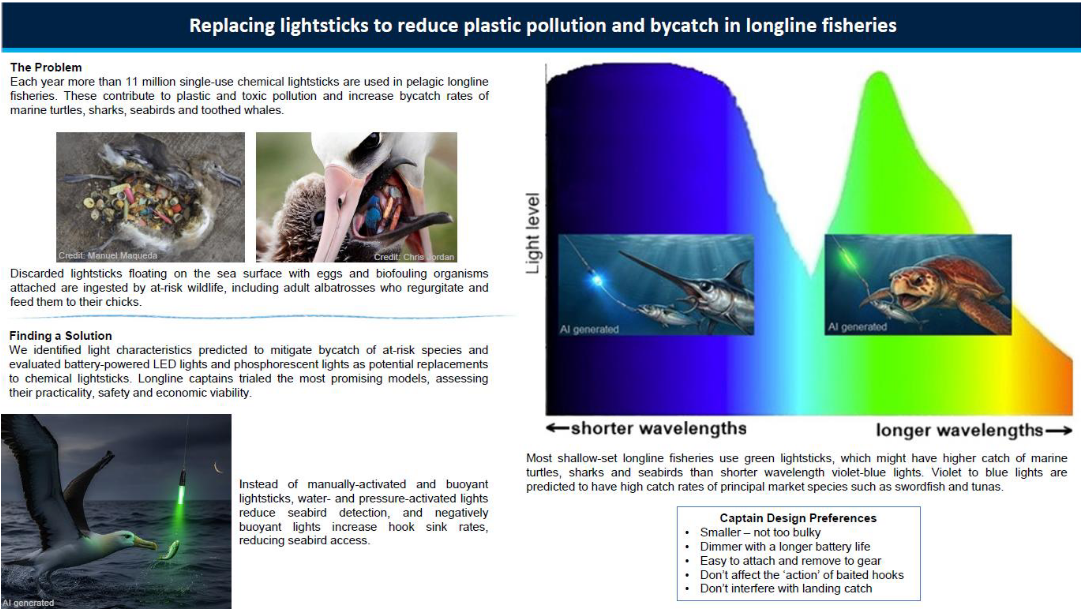
Graphical summary of approach and key findings to investigate candidate pelagic longline fishing lights’ potential effects on economic viability, practicality, crew safety, and catch rates of at-risk bycatch species.