
What Are Ecotypes, and How Can They Help us Understand Biodiversity?
For Quanta Magazine, environmental journalism fellow Marlowe Starling reports on the genetic basis of “ecotypes.”
Anyone who has taken a biology class has likely seen a diagram of Darwin’s finches. They’re often used as an example of rapid evolution and adaptive radiation. In his seminal work On the Origin of Species, based on his travels to the Galápagos Islands in the mid-19th century, Darwin introduced the theory of natural selection that shaped how Western science approaches evolutionary biology for decades to come. Using the finches as his keynote example, Darwin described how the birds evolved different beak shapes and sizes specialized for eating specific types of seeds as a result of the birds filling different ecological niches: the various roles organisms can perform in an ecosystem.
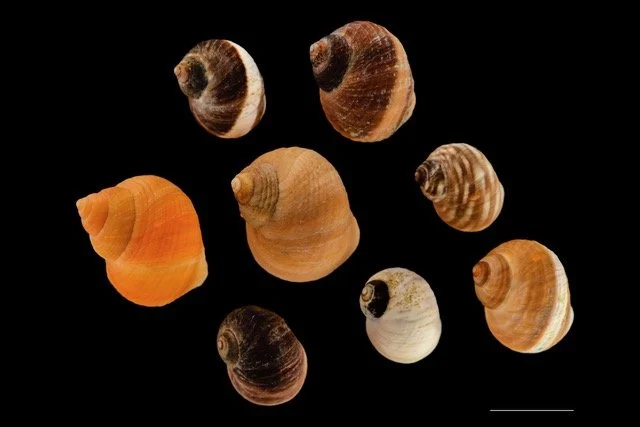
This is a single species of marine snail, Littorina saxatilis, that has been misidentified as a species or subspecies over 100 times due to its highly diverse physical traits that comprise its many ecotypes. The snail lives on coastlines in Sweden, the United Kingdom and Spain and is a standout example of parallel evolution: when the same traits evolve in separate populations due to similar environmental conditions.
Photos courtesy of Kerstin Johannesson, evolutionary biologist who studies marine snail ecotypes.
This concept provides a strong basis for the biodiversity that blankets Earth today. But in a recent story I reported for Quanta Magazine, I learned that this engine for genetic diversity is much more complex — and genomics research has helped clarify how this happens at the molecular level. There are chromosomal mechanisms at play that put forth the idea that Darwin’s finches aren’t separate species at all — but rather, different forms of the same one. It partially comes down to how we define species, but also how DNA finds unique ways of helping species thrive in varying environmental conditions.
“An ecotype is a population — a group of individuals in a species — that has unique characteristics that allow them to adapt to the particular environment where they live,” explained Marco Todesco, a plant geneticist working on adaptation at the University of British Columbia.
Todesco studies ecotypes in wild sunflowers, which he finds useful for understanding the nebulous boundary of speciation. Where a species starts and ends, he said, is really a judgment call, and ecotypes provide a useful tool for studying this boundary in closer detail.
There are roughly 50 species of wild sunflowers across North America growing on sand dunes, in deserts, across salt marshes, on flooded plains, in coastal areas, and more — each showing strong adaptation to different environments. But it’s within individual species that Todesco takes interest.
Take the silverleaf sunflower, endemic to central and southern Texas, for instance. It has two ecotypes: a coastal type that flowers in the early summer, and an inland type that flowers two and a half months later — possibly to avoid flowering in the middle of a hot, dry summer when water is more scarce, he explained to me.

Plant geneticist Marco Todesco studies ecotypes across different populations and species of wild sunflowers. The silverleaf sunflower, depicted here, exhibits two ecotypes in coastal and inland environments that flower at very different times in the year.
To find out which genes control the traits for these plants to survive in such diverse environments, he conducted common garden experiments, which were first done by the Swedish botanist Göte Turesson, who first coined the term “ecotype” in his 1922 work, Hereditas. Todesco put different ecotypes of sunflowers in a single field, and then sequenced their genomes. “We found these very large regions of the genome that are controlling many different traits that are important for adaptation [and] are unique to these ecotypes,” he told me.
Underlying those characteristics are hundreds of genes and millions of DNA base pairs that stay locked in place and are inherited together. These genomic regions are called “haploblocks,” but in simpler terms, they effectively work like “supergenes,” he explained. That’s the secret behind how ecotypes remain distinct even if they are constantly swapping genetic material through mating or cross-fertilization.
These ecotypes, it turns out, exist across the tree of life — from microscopic, single-celled cyanobacteria to iconic macrofauna like killer whales.
Read the full story, “How Ecotypes Harbor the Genetic Memory of a Species’ Past,” for Quanta Magazine.