
Effects of Fishing & Whaling on Blue-Water Ecosystems
By Emeritus Fellow Eric Gilman
A new publication in the ICES Journal of Marine Science benchmarks the state of understanding of the effects of fishing and whaling on blue-water ecosystems. Fisheries are a main driver of change and loss in marine biodiversity. While commercial whaling has been subject to a global moratorium since 1983, most whale species remain well below pre-exploitation levels, and some populations remain at very low levels.
The figure below presents attributes of blue-water ecosystems with the strongest evidence of responding to pressures from fishing and whaling. There was strong evidence of changes in food web processes, including reduced efficiency of the transfer of biomass and energy from lower to higher levels of the food web. This might have been caused by fishing and whaling having shifted the size structure and composition of upper food web levels from dominance by larger, relatively low productivity, late maturity, and slower growth species to smaller, high productivity, earlier maturity, and faster growing species. Regime shifts—protracted or permanent changes in structure and functioning—were detected in partially enclosed marginal seas, which are subject to a relatively broad range of human pressures. There is limited information on some human pressures on open water systems.
Major evidence gaps include effects on blue-water ecosystems from the recent proliferation of artificial fish aggregating devices used by tuna fisheries and from derelict fishing gear. Importantly, there are also gaps in our knowledge of the effects on the evolutionary characteristics of populations from fisheries and whaling selectively killing individuals within populations with certain heritable traits, such as targeting the largest fish and whales.
The findings support management authorities to maintain blue-water ecosystems in desirable states and safely above limit thresholds by accounting for broad, ecosystem-level effects of fishing and whaling.
The study was conducted by Eric Gilman, Safina Center Fellows Network, Nathan Taylor, International Commission for the Conservation of Atlantic Tunas, and Milani Chaloupka, University of Queensland.
Gilman E, Taylor N, Chaloupka M. 2026. Effects of fishing and whaling on the structure and dynamics of blue-water ecosystems. ICES Journal of Marine Science DOI: 10.1093/icesjms/fsag055
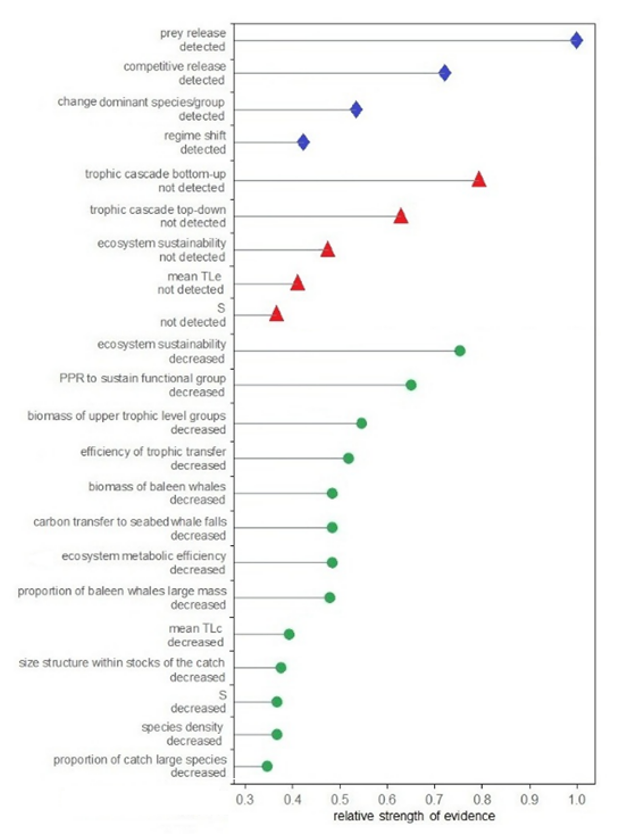
Attributes of blue-water ecosystems with the strongest evidence of responding to pressures from fishing and whaling, based on: (1) the prevalence of the pair, (2) robustness of the study approach, and (3) length of the study time series. Blue diamond=detected, red triangle=not detected, green circle=decreased.