
Another Bumper Crop OʻTross
Mōlī Nest in Record Numbers on Kauaʻi
Hob Osterlund, Safina Center Conservationist in Residence
My phone rings on a late Friday afternoon on the 4th of July holiday weekend. Caller ID says itʻs Ron, my neighbor.
“Hey Hob, I think I have your bird,” he says, excited. He and Helen are a few blocks away, at the corner of a busy intersection. They have spotted a rather baffled-looking mōlī fledgling, and sheʻs headed in the direction of vehicular traffic.
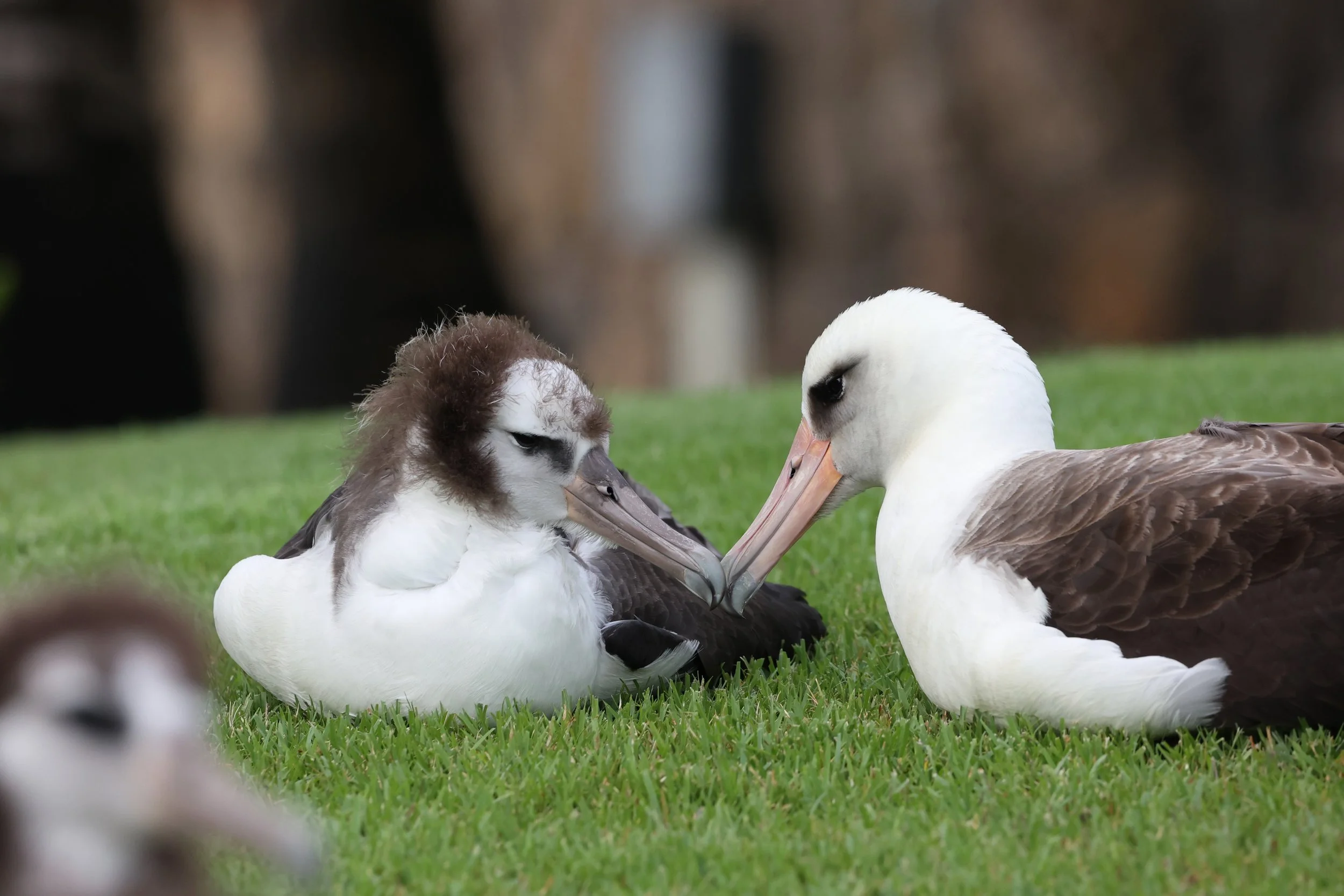
When a mōlī chick is visited by a parent (in this case, her father) for the last time, they often spend long hours together. Feeding is no longer their dominant interaction. Photo Hob Osterlund
This particular bird grew up in a nearby backyard—which is not uncommon for wild albatross in this small north shore community —and the property owner had dubbed her Angel.
Ron agrees to stay riveted to Angelʻs every move for a few minutes until I can get there. At this point she has been evading us for more than a day, and can disappear if you lose focus for even a few seconds. For about thirty-one hours, a dozen people have been on and off involved in the search. She has attempted flight, gotten stuck in thick vegetation, gone missing on a golf course, and somehow made it over a fence going the wrong direction. She wants badly to catch a NE wind and take off over the ocean, but cannot find a viable route.
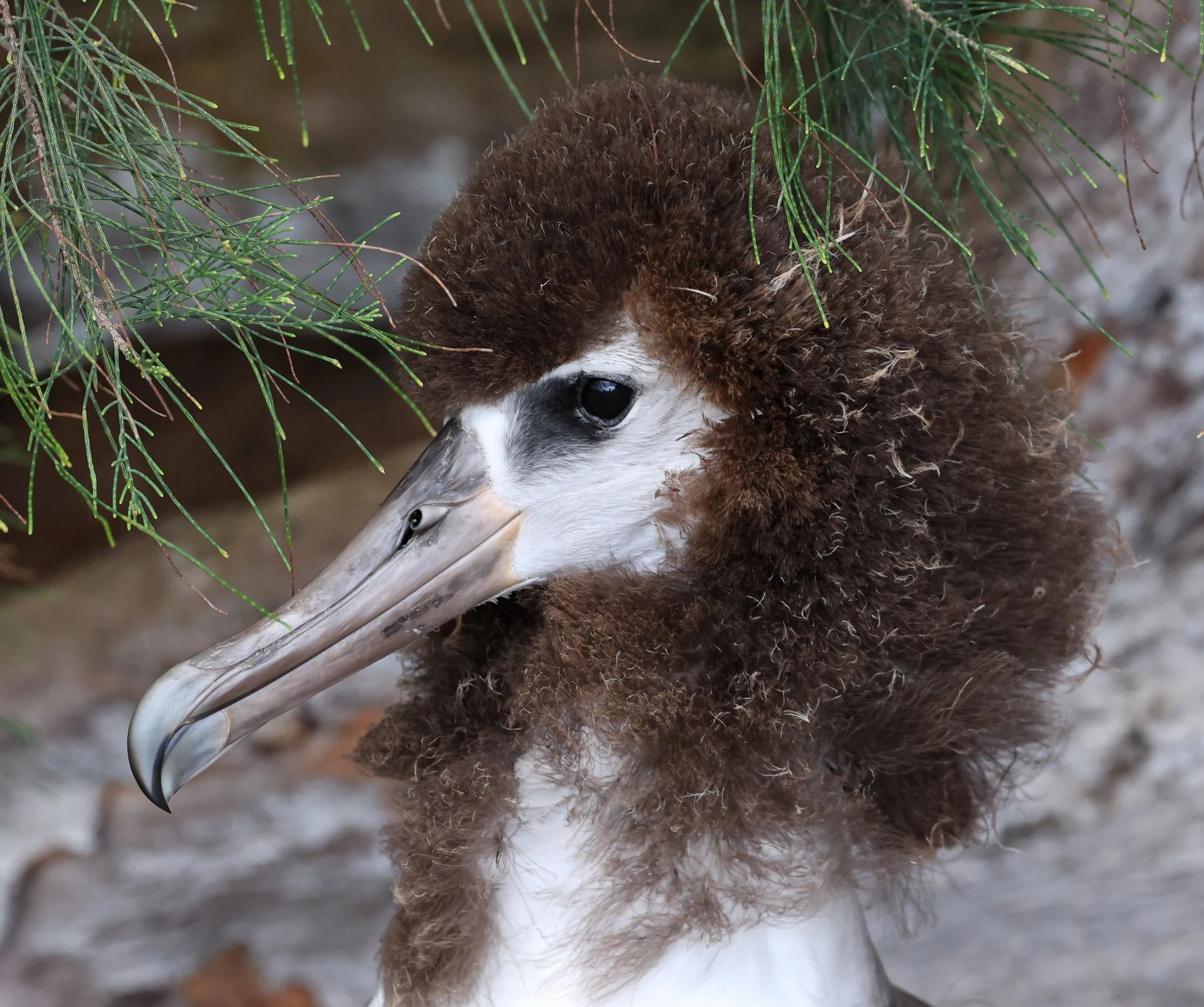
In the month before mōlī chicks fledge, they often sport entertaining hairdos. Photo Hob Osterlund
Ron and Helen already have a towel in their truck, and I toss them another. They drape the towels so they form a brightly-colored fabric screen to prevent Angel from stepping into traffic. I come from behind her with a dog kennel, and next thing you know, she’s safely inside it.
As had already been authorized by the good folks of the State Department of Fish and Wildlife, we transport Angel to a protected bluff a short distance away. She hops out of the kennel, spreads her wings, and runs toward the sea. She knows exactly what she wants. Within a few hours—perhaps when she determines the trade winds are perfect—she fledges.
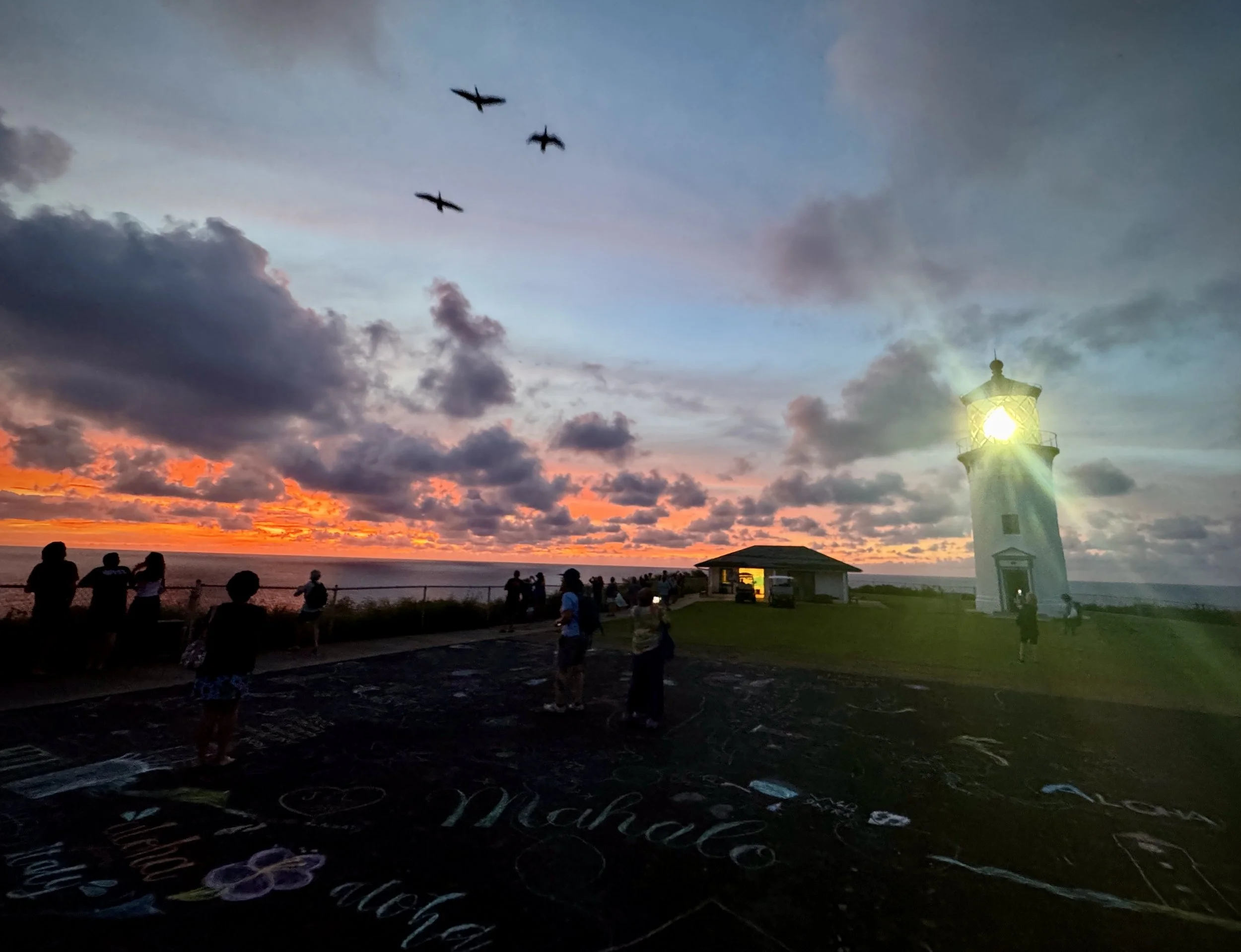
Sunset at Kīlauea Point National Wildlife Refuge, Kauaʻi. KPNWR hosts two significant albatross colonies which this year represented 42% of the mōlī nests on Kauaʻi. Photo Hob Osterlund
With that, Angel becomes a statistic, in a good way. Out of a record of 464 mōlī nests this year, a total of 308 chicks survived to fledge. This is measured in a number called “reproductive success,” meaning what percentage of eggs resulted in a fledged chick. In this case, itʻs just over sixty-seven percent. Also a record.
Of course, most of the credit for that success goes to the chicksʻ parents. It means they successfully found each other, got sperm to the right egg, incubated the hard-shelled version for more than two months, then managed to find enough food for both themselves and their growing babe for another five to six months. Each one of their foraging trips might have logged thousands of flight miles. Raising one chick takes unbelievable tenacity and devotion, not to mention wayfinding.
In the month before mōlī chicks fledge, they regurgitate an indigestible “bolus” of squid beaks. Plastic bits inadvertently swallowed/fed by parents are always part of the bolus. Video by Jeanine Meyers
Credit also goes to the chicks themselves, who are left alone when theyʻre only two to three weeks old. They tolerate solitude, heat, bucketing rain, hunger, high winds, and the worst predator on the globe, mosquitoes. In this case, mosquitoes delivered horrific avian pox. Some of the chicks this year got blinded in one eye, and some of their bills got malformed. Several died. For many others, surviving pox lesions required an incredible will to live.
Humans get plenty of kudos too, largely in our ability to keep four-legged predators away. That means maintaining fences strong enough that ravenous 200-pound feral pigs cannot dig under, 2,000-pound black Angus bulls cannot push over, and excited hunting dogs cannot jump over. It means trapping feral cats, for whom all but the most expensive fences mean zilch.
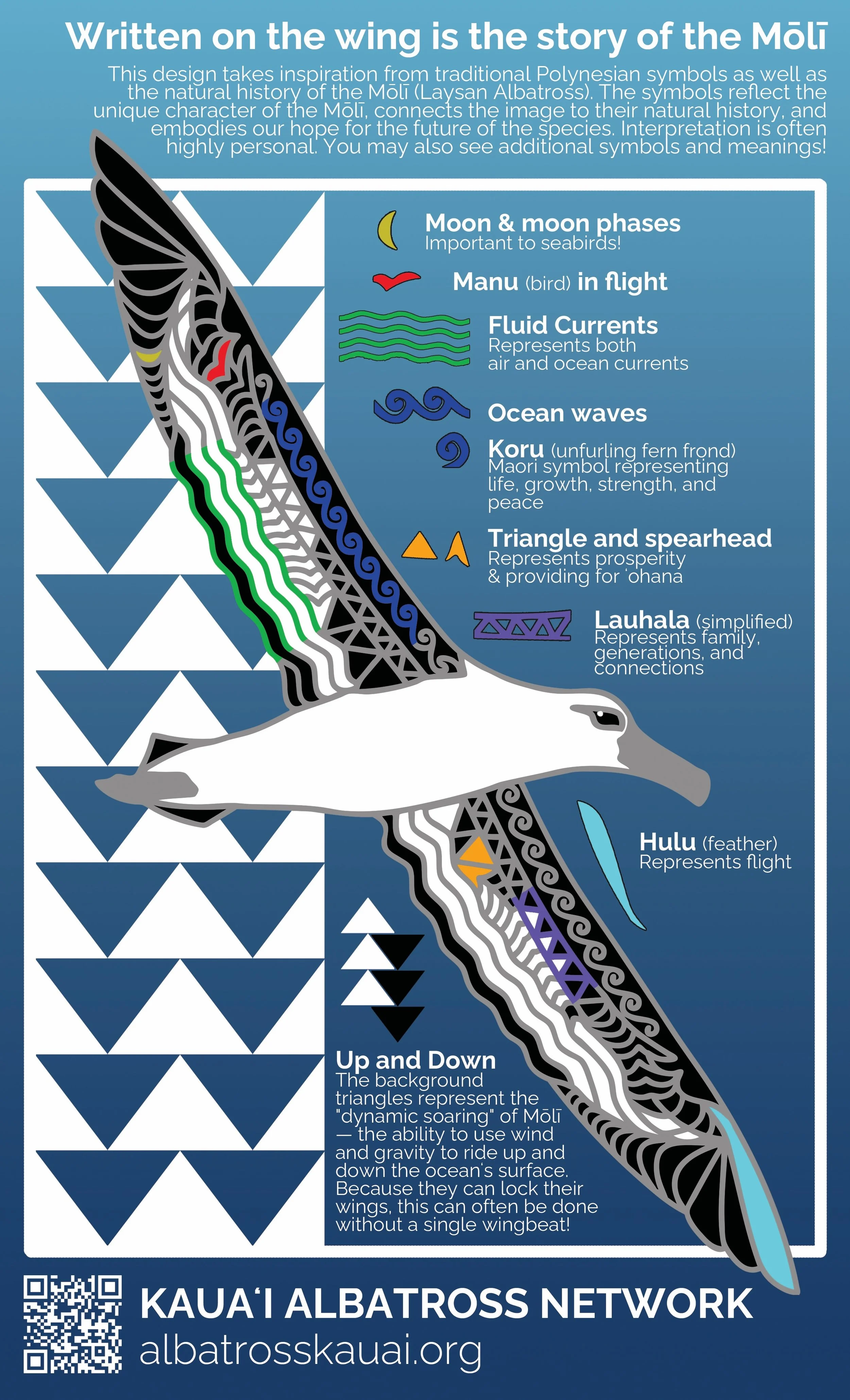
Tribal art of a mōlī, including meanings of the depicted symbols Graphic art by Rae Okawa
It also means the maintenance of a network of people who can stay vigilant, know when and whom to call in the event of a threat or attack, understand what mōlī behaviors mean and when theyʻre abnormal, cover the necessary costs, drive injured birds to be admitted to care when required, be expert and licensed to do the actual lifesaving rehab, donate supplies, provide public education, answer media inquiries, advocate for important legislation, post on social media, create stunning works of art, write books, lead field trips, inspire children, raise funds, support research, and much more.
What makes it all worth it? Numbers like 464 and 308 and 67%. Seeing mates reunite, watching chicks hatch and thrive, laughing at their adolescent hairdos, witnessing the parting moments between parent and child, being there when the almost-adult babes jump from a cliff for the first time.
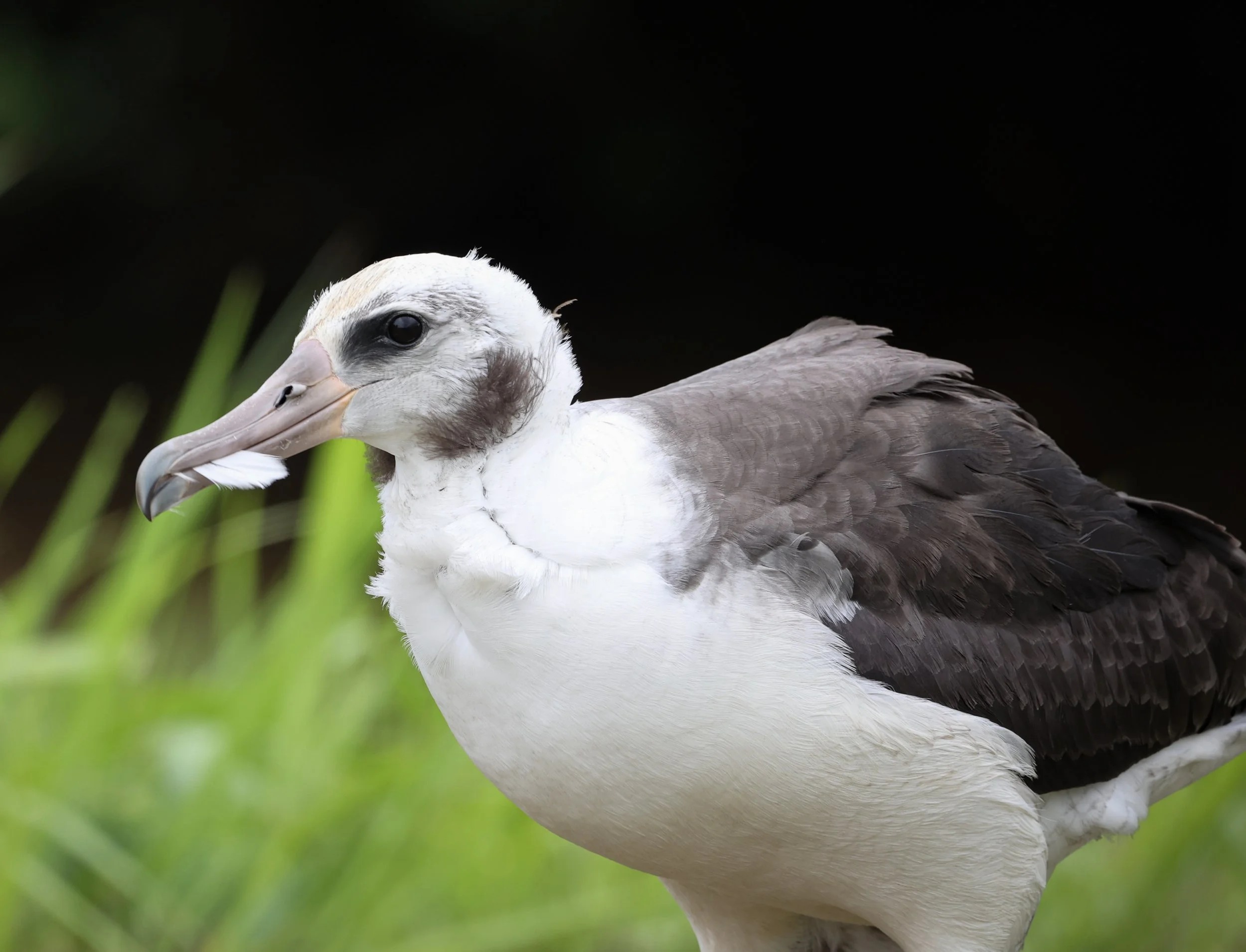
A ready-to-fledge albatross chick carries around a feather, not unlike Dumbo. Photo Hob Osterlund
We do it for the success, sure, but we do it when weʻre unsuccessful too.
Itʻs all for the birds. In a good way.
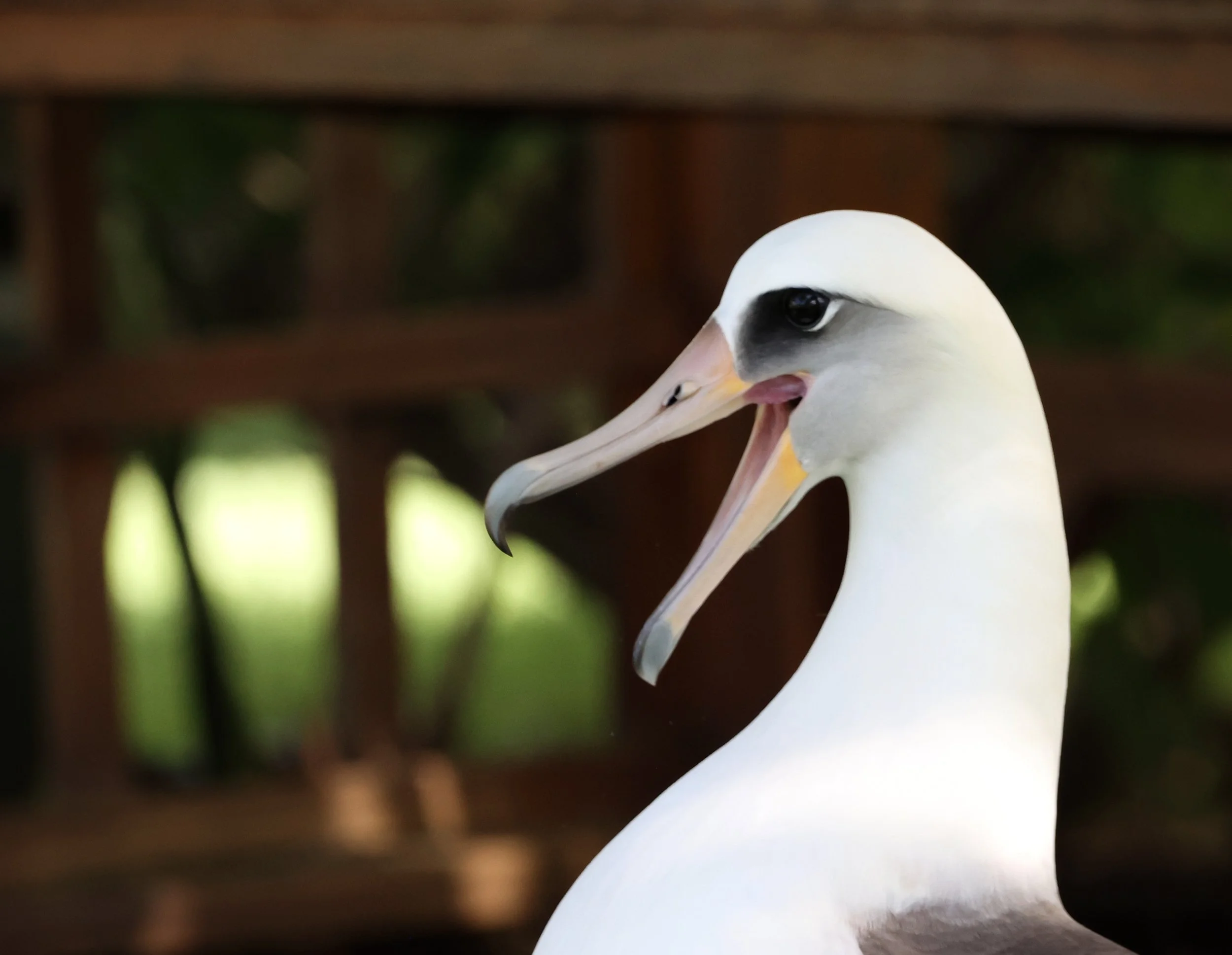
A mōlī adult, now five years old, returns to her natal home on Kauaʻi for the first time. Here she practices courtship dance moves with another young albatross. Photo Hob Osterlund