
What The Clean Air Did For Fish
Revisiting the once-decimated brook trout ponds of the Adirondacks
by Writer-in-Residence Paul Greenberg
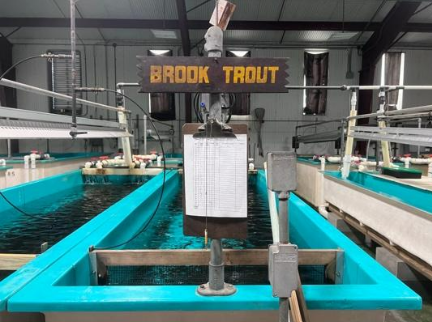
The South Otselic Hatchery, where heritage brook trout are raised © Paul Greenberg
People too young to remember the days before the Clean Air Act (i.e., most Americans) don't know how bad we had it. Not only were our skies darkened by particulate matter and nitrous oxide, our waters were critically damaged by smokestack emissions. In the Midwest, coal-fired plants put out excessive amounts of sulfur dioxide, which, when hitting moisture in the atmosphere, converted to SO3, drifted east with the prevailing winds, and fell on sensitive Adirondack lakes in the form of what came to be known as "acid rain." This summer, TK years after the Clean Air Act was passed by a bipartisan act of Congress, I took a pair of my New York University Animal Studies students north to the largest park in the United States for Adirondack Life Magazine to report a story on the revival of brook trout ponds.
As this is a story-in-process, I won't give away too many of the details in this short post. But what I will say is that amidst all of the bad news and deregulation of environmental controls, Adirondack brook trout stand out as an unmitigated success. The pollution controls the Clean Air Act imposed upon American industry improved things markedly for us and for fish. Not only did the researchers from the New York State Department of Environmental Conservation we covered find native brook trout in ponds that had lost their endemic populations decades ago, but there is now a bold and far-reaching plan on the books in the state to help reintroduce brookies to ponds that haven't quite made it back. All this is being aided by a deeply committed group of citizen-scientist anglers who are hiking into remote brook trout ponds, taking measurements of fish and water samples, and helping to assemble a real-time picture of this unique mosaic of precious waterways.
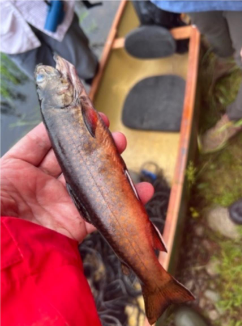
A native brook trout taken by samplers in a lake previously thought devoid of brookies © Paul Greenberg
I mention all this now because while the bones of the environmental movement have been shaken by the present administration, they have not been shattered. We still have some of the best water and air protections in the world. These protections create real-life improvements for citizens, whether they want to drink a clean glass of water or hike into the deep woods and catch trout dizzying in their coloration and delicious on the table.
Adirondack Life Magazine, which this year won for best magazine in the International Regional Magazine Awards, will run the completed article in a spring 2027 issue. The article will include coverage of sampling efforts, a look at citizen scientists fishing and data collecting, a historical lookback at how our waters came clean again, and even a backwoods flyover as state officials reintroduce rare heritage strains of brook trout to ponds too remote to reach by foot. Along the way, student journalists Ella Gatfield, Samantha Falawee, and Wendy Benitez-Jaramillo will contribute research and reporting. It is, in short, a truly collaborative effort helping to bring light to an important success story in the environmental movement.
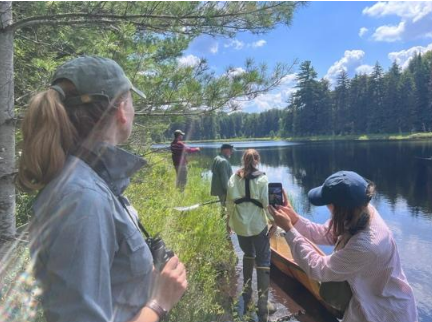
Student journalists Samantha Falawee and Ella Gatfield with DEC researchers in a remote brook trout pond © Paul Greenberg